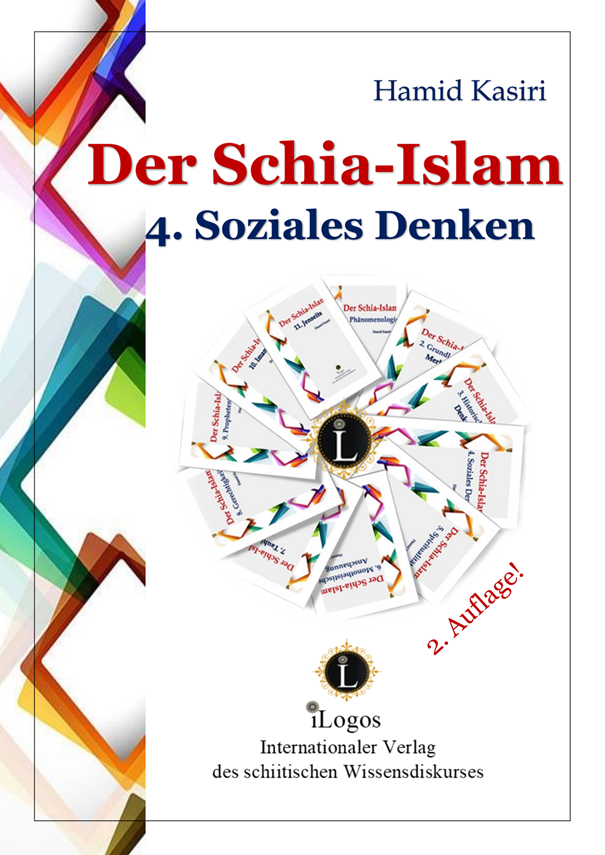
Der Schia-Islam 4. Soziales Denken (2. Aufl.)
Volume 4 (Social Thought) sees itself as a contribution to the discourse on Shiite social thought with three main topics:
1. pastoral,
2. political and
3. economic thought.
Through this study, it becomes clear that the more one devotes oneself to the social thinking in Islam and exposes the contours of their most important thoughts, the more the legacy of Shia thought and the importance of its representatives come to the fore.
The preservation of the identity of the Islamic world community (Ummah) in today’s world is of great relevance, and it can only continue if Muslims can remain in close contact with their history - and in particular with their faith history. This leads to a dialogue based on the perception and understanding of the other.
That is why this study - both in this book and in other volumes - has followed the teachings of Shia Islam - with respect with members of other religious communities. By simultaneously proclaiming the authenticity of Shia Islam, presenting its schools of thought and explaining the reasons for its appearance, it deals argumentatively with other religious communities.
It tries to show that Shia is a completely original aspect of Islam - without the slightest intention of having in mind strife or division between Shiites and Sunnis or contempt for Christians. On the contrary, defending the authenticity of Shia Islam facilitates dialogue - both between the two main denominations of Islam and between Islam and Christianity. This - while preserving one's own identity - is a real rapprochement on dialogical and ecumenical levels.
It is important for Europeans to get to know this dimension of Shiite thinking. In the European context, until now there has been more talk of “buildings”. So far, only the facades of the contents have come to light; and the essence of Shiite thought and faith was less discussed. In particular, there was a lack of first-hand educational work. This study aims to present an up-to-date picture of Shiite faith and thought in order to preserve it for future generations.
For this reason, Shia Islam does not regard the modern era as a threat to the Islamic faith and the Islamic world community (Ummah), but as a call, indeed as an essential opportunity to deepen faith and thought. This is important in itself, since “hardly any Islamic faith has become the focus of world public interest in the last two decades as much as the Shiite faith. As old as Islam itself, the Shia has undergone a historical development in which it has always been a sometimes tolerated, sometimes relentlessly persecuted minority, striving for the practice of Islamic commandments and regulations in all aspects of human life.” (Tabatabai, Sayyid Muhammad Husayn (Allama): The Shia in Islam. Islamic Center Hamburg, Hamburg, 1996, p. XI.) To illustrate this fact, three topics are covered in this volume:
- In the mirror of pastoral thinking.
- In the mirror of political thought.
- In the mirror of economic thinking.