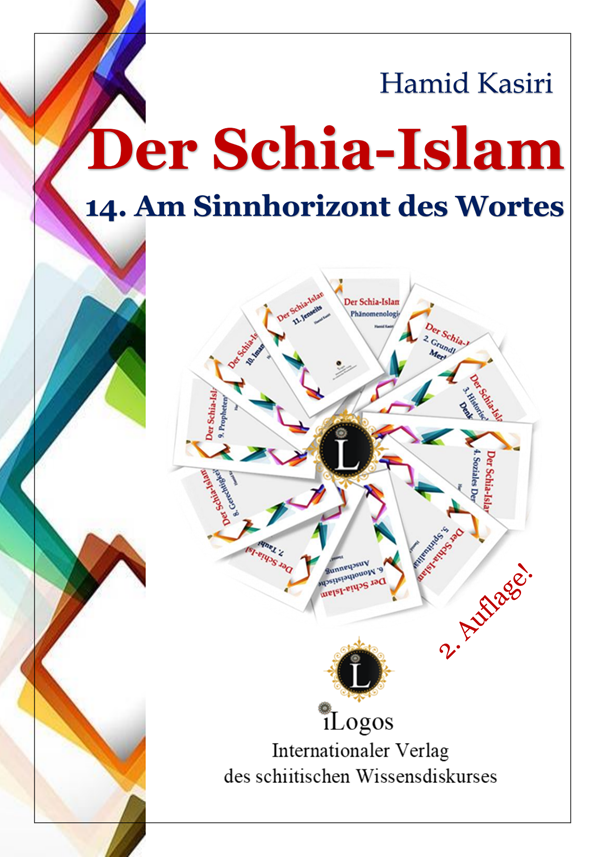
Der Schia-Islam. 14. Am Sinnhorizont des Wortes (2. Aufl.)
Volume 14 of the series “Shia Islam” deals with the topic “On the horizon of the meaning of the word”. This study attempts to broaden the horizon of the esteemed readers with regard to the Islamic understanding of revelation and to show them appropriate approaches to it. This is learning to understand that includes other topics. This doctrine of understanding also brings with it a life practice in order to:
- to awaken in people the highest non-violent-hermeneutical interest.
- to make them aware of their own identity as “readers of the word”.
- to show them the wide horizon of Quranic revelation.
Therefore, this study intends to address some burning questions. It wants to answer the question of what the Islamic understanding of revelation is.
The Quran is one of the most important books in human history, which is why people have dealt with it intensively and continue to do so. The intensity with which the Quran is studied today in so many religious and scientific circles is a cause for joy for Islamic communities in general - and for me as a Muslim theologian in particular. At the same time, however, it is a challenge to clarify one’s own assessments of the Quran and one’s attitude towards it anew. We can even add to our joy that many believers in the West have rediscovered and, as it were, reactivated the belief in the Holy Quran as a unique source of faith and guideline for faith - more clearly than ever before.
We welcome every scientific question that is asked of us as Shiites and of our belief system, as Shia Islam. We will cover some important of them here:
- What is the Shiite understanding of revelation?
- Specifically, does Shia Islam consider that the current Quran does not fully agree with the Quran that was sent down to the Prophet (s)?
Shia understanding of revelation is based on the originality of the present revelation, the revelation that we now have in the Holy Quran.
Within the framework of this study, the following important topics may be addressed or put up for discussion:
- Revelation.
- Word of God.
- The relationship between revelation and the word of God, (Quran and revelation / Quran and word of God).
- The question of the perfection of revelation.
- Word and Holy Spirit.
- The authority of Quranic revelation.
- The Revelation Authority of the Prophets.
- The interpretive authority of the infallible Imams.
- Tradition and Revelation; (this includes, for example, the question of the hermeneutical significance of tradition).
- The challenge (اَلتّحدّی) and the miraculous quality (اَلإعجَاز) of the Quran.
In addition to answering these questions, this study also aims to provide suitable answers to the following questions as an introduction to the topic:
- What is the Quran?
- Just a copy of earlier books of revelation or an independent book of revelation?
- Is it a book of revelation or the book of revelation?
- A collection of old precepts and prohibitions or a completion of the books of revelation?
- Is it one book or several books?
- Is it a book or more than a book?
- Is it a textbook? If so, who is the teacher? Who are the students?
- Does it have a limited validity, or is it valid forever?
This must be clarified in order to be able to understand why the Quran has been interpreted so differently in the course of history.